Sunday, 15 January 2017

Bunker update

For the first post of 2017 I'd like to go through the recent construction works carried out on 6 bunkers on the course. The bunkers on the 7th, 10th, 15th & 17th have all been reshaped and the Bunker Blinder base installed in them.
The reasoning behind these works is over time with edging carried out to present the bunkers the edges of these bunkers, and many others around the course has been lost. This has led to some bunkers becoming both difficult to maintain and equally so difficult to play out off.
The addition of the  bunker blinder layer gives us a product that will drain, the sand won't become contaminated and due to the nature of the installation the bunker shape is retained due to a solid base with which we can constantly put a nice, clean fresh edge.
The bunkers have been shaped to reflect the parkland nature of the golf course, add feature and depth to the holes but yet create a hazard that is playable.


The above image shows the greenside bunker on the 18th, over time the original shape has been lost and the drainage no longer functions.

The construction process of the new bunkers would involve reshaping, installation of new drainage systems, the addition of the blinder layer then returfing. The working area of the new bunkers would involve the immediate surrounding area around the bunker so the bunker would fit into the shape & feel of the land.


For the bunker renovation projects we again worked alongside Profusion who supplied expertise & equipment for the project, especially in the shape of Connor Walsh who was to be the lead shaper on the project.


Once the initial shapes had been formed,  the next stage was to fine tune the bunker shape by highlighting the sand lines of the bunker. These are basically the top line of sand coverage that is visible when looking at the bunker. These are important as they can add shape & depth to bunkers which can in turn enhance how a hole is played.


Once the sand lines had been finalised the bunker drainage was installed and then a layer of aggregate added that is crucial to the blinder layer installation.   


The next stage is the laying of the blinder layer. This is a combination of recycled rubber granules and a binding agent that give the bunker it's drainage characteristics whilst providing a solid shape that the bunker will retain. Once the blinder is layed to a depth of 25mm, a revetted edge is layed, top soil spread around the area and then the area is re-turfed. 


As can be seen from the above images the greenstaff have again put in a tremendous amount of dedication & skill to get these works finished, including turfing in the dark...!!!!
The bunkers will now be given time to 'bed & knit in' with opening planned for mid-March - early April.

Once again I appreciate your understanding whilst we carry out these works on the course as we aim to continually improve the golfing experience at Muswell Hill Golf Club.


Sunday, 27 November 2016

The joy's of Autumn

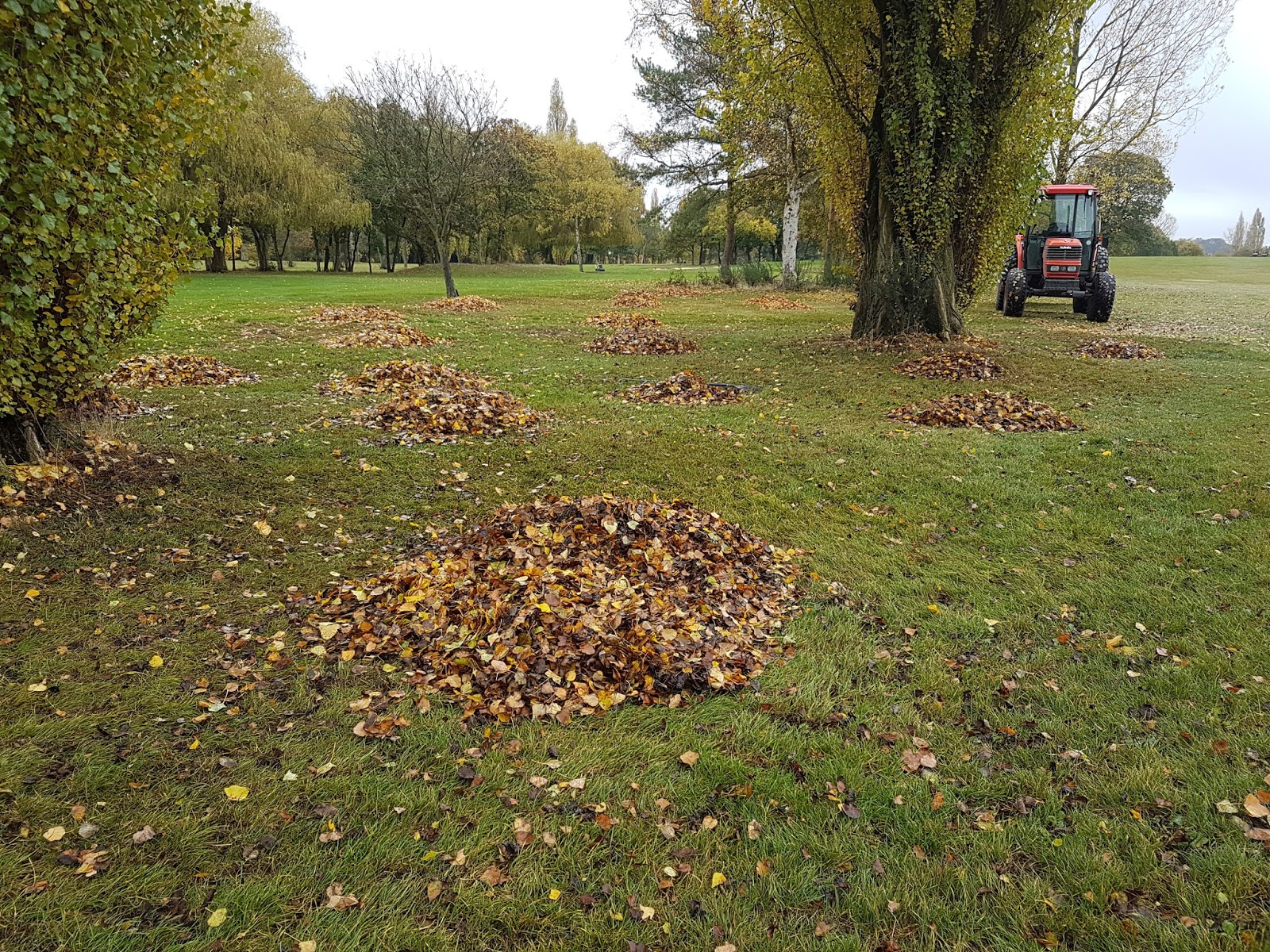
During the year many challenges are presented on the golf course that we must overcome in order to improve the playing surfaces at Muswell Hill. Difficult weather, high disease pressure but to name two but by far the most frustrating is the annual leaf clearing that we under take each autumn.
Being a parkland course we have a large number of trees around the course, and this adds to the attraction of playing golf at Muswell Hill but come the autumn this large number of trees means large numbers of leaves. Estimating how many leaves we have on the course is a hot topic of discussion in the Greenkeepers shed at the moment. Estimations of between 300,000 to 1.5 million have been raised. I've discovered there is a concept called the Leaf Area Index(LAI) that has based mathematical formula and crown size of trees to work out how many leaves are on trees.
I think I'll just go with there's a lot....

So how do we tackle the problem of trying to clear the playing surfaces of leaves.
On the greens & tees we use backpack blowers and blow the leaves off the playing surfaces. In terms of man hours this takes 6 hours a day. Obviously just blowing leaves around the golf course isn't  a very efficient way of making sure the surfaces stay clear as the wind has a tendency to blow them right back. So we also use a tractor operated vacuum/sweeper machine, the Trilo, which collects the leaves. These are then deposited at our compost site to be incorporated into future top dressing's for the surfaces. To clear areas we have a two different blowers that we use.
The strategy is to blow out areas and collect them with the Trilo. During this time of year 2/3 Greenkeepers a day are on this duty, equating to 21 + hours a day. Then there's also the ditches that need to be cleared.
The recent weather has been fairly dry so idle for picking the leaves up but it had also been very windy that isnt particular helpful when trying to blow leaves into position.
So next time your out on the course and an area is covered in leaves, just take a minute to see how many trees are around and try and equate that into how many leaves that could be. The leaf clearing team will be out somewhere on the course, continuing to hoover up and trying to clear the surfaces and also casting frustrating glances upwards as the wind disperses the pile we've just spent ages getting ready to clear.       
The joys of Autumn......


Wednesday, 9 November 2016

Making the Greens Great Again........

Sometimes when I sit down to write these posts I struggle to think I'll find anything that will keep peoples interest. But this post isnt really one of those posts.
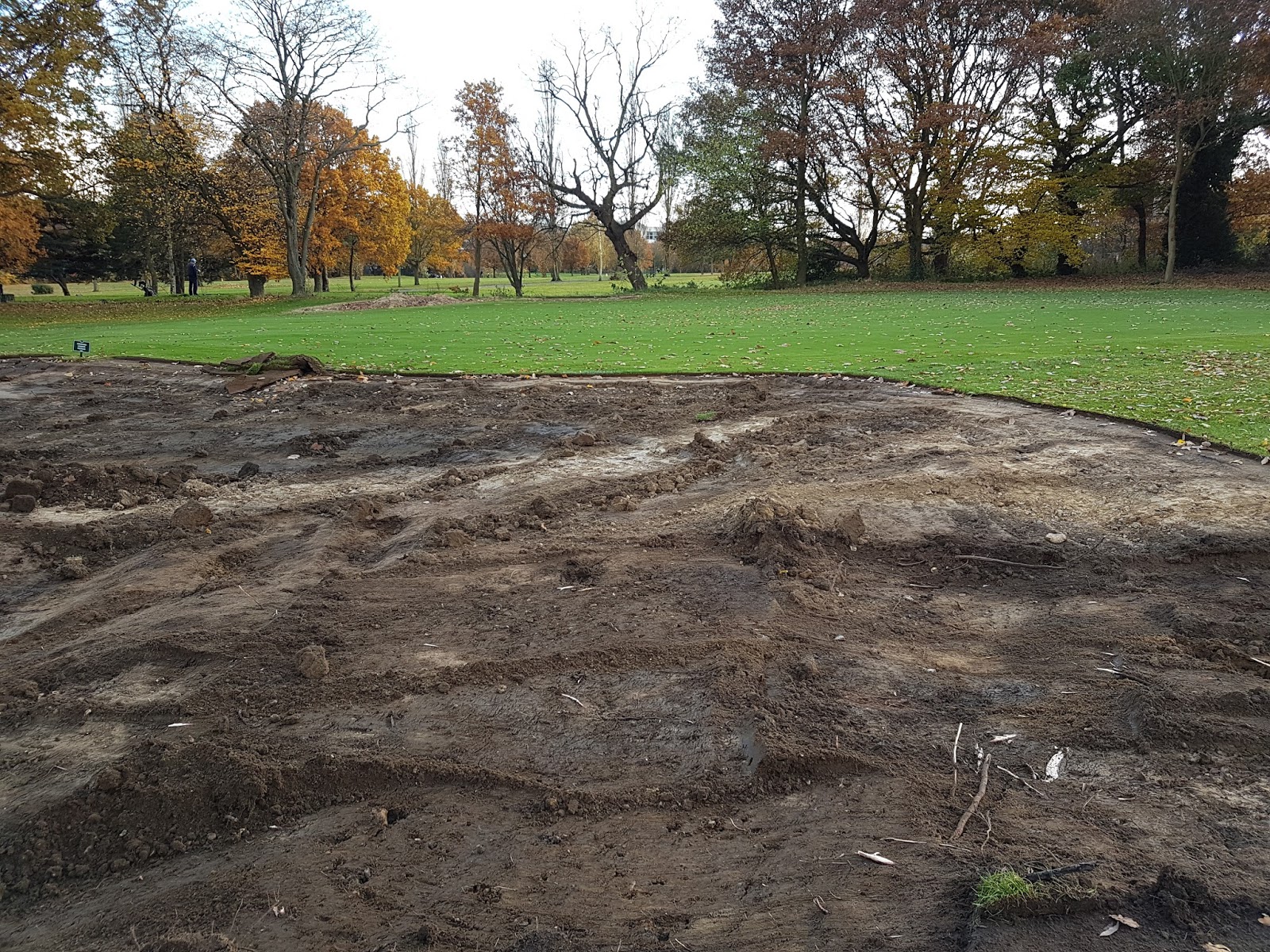
The greens drainage works have been completed within schedule, so 5 further greens have had primary drainage systems installed into them that will enable us in time to link the drainage up with secondary drainage like sand slits. The schedule I set out was always asking a lot, broken down we were looking at completing the works on each individual green in 3 days. That was from the drainage runs being marked out, the turf lifted, trenching works carried out & then pipe, stone & rootzone added. The turf is then relayed. Quite a lot of work to get done in 3 days!!!! Once again the greenstaff, working with the contractors worked tirelessly & with dedication to complete the tasks within schedule. Working 12 hour + shifts enabled the work to be finished. Without this work effort the work would have taken longer & the disruption would have lasted longer. That as I've mentioned previous is something I'm always conscious off and once again I thank the membership for their understanding whilst we carried out this latest stage of course development works.


So the focus will now shift to getting the greens back in play as soon as possible and preparing the golf course for the winter.